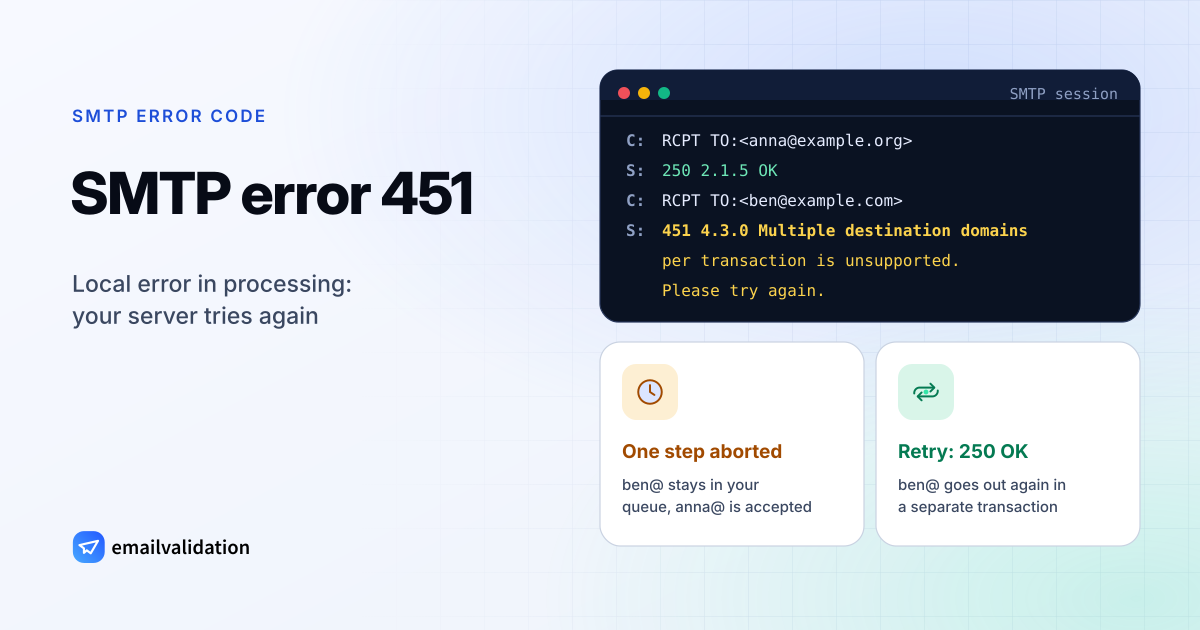
What SMTP error 451 means
RFC 5321 defines SMTP error 451 as “Requested action aborted: local error in processing”. The first digit, 4, makes it a temporary failure; RFC 3463 describes that class as one where “the message as sent is valid”, but a temporary condition caused “abandonment or delay”.
Unlike a 421, a 451 doesn’t announce that the whole service is going away. It aborts one step, often one recipient or one message, and leaves your server to try that step again later. Your server queues the message and retries on its own schedule. You only see a bounce, a soft bounce, if the condition outlasts the retry period.
451 messages from Gmail, Microsoft 365 and Yahoo
Most 451s in practice are not local errors at all. Providers use the code whenever they want you to come back later.
| Sent by | Reply | Reason |
|---|---|---|
| Gmail | 451 4 | A temporary problem on Google’s side |
| Gmail | 451 4 | One message addressed to several domains in one transaction |
| Gmail | 451 4 | The connection was too slow |
| Gmail | 451 4 | Missing or mismatched reverse DNS for your IP |
| Gmail | 451 4 | Your SPF record |
| Gmail | 451 4 | DMARC couldn’t be evaluated because of DNS |
| Microsoft 365 | 451 4.7.500 to 451 4.7.699, with an ASxxx tag | IP throttling: a sudden rise in volume from your IP |
| Yahoo | 451 | Temporary block: unusual traffic, complaints, busy servers, failed lookups |
Sources: Gmail SMTP errors and codes, Microsoft’s article on 451 4.7.500-699, Yahoo Sender Hub. Yahoo also answers 451 when the domain in your MAIL FROM or From address can’t be resolved because of a timeout or SERVFAIL; a permanent DNS failure gets 554 instead.
Greylisting and IP throttling
Some 451s are deliberate. Microsoft says its 4.7.500–699 replies appear when “the source IP address that’s sending you email changes significantly from its previously-established patterns”, and calls this part of “a filtering technique known as graylisting”. Classic greylisting, described in RFC 6647, refuses the first attempt from an unknown sender with a temporary error and accepts a later retry. The RFC’s suggested default window for that is one minute to 24 hours.
A greylisted message arrives late, but it arrives, as long as your server retries. A related code, 451 4.7.1, is a temporary refusal for a policy reason; the 5.7.1 status code page explains how its permanent and temporary forms differ.
How to fix SMTP error 451 as the sender
- Make sure something retries. Mail servers and email services do. Scripts and apps that talk SMTP directly often don’t; RFC 6647 warns that clients that never retry lose mail to greylisting. Queue the message and try again after a delay.
- If one domain keeps deferring you, read the enhanced code. The list of SMTP error codes explains each one.
4.3.xand4.4.xpoint to the receiver or the network;4.7.xpoints to your setup or reputation. - Reverse DNS (Gmail 4.7.23): ask your IP’s owner for a PTR record that matches your server’s host name, and an A record for that name pointing back to the IP.
- SPF and DMARC (4.7.24, 4.7.26): clean up your SPF record with the SPF record generator, and make sure your DNS provider answers reliably; the SPF checker shows what receivers see.
- New IP or sudden volume (Microsoft 4.7.5xx): ramp up gradually. Microsoft says the error goes away as you build a sending history over a few days. Microsoft also advises against sending more than test messages from a tenant’s initial onmicrosoft.com domain.
- Gmail’s multiple-domain rule: send one transaction per recipient domain. Most mail servers do this already; custom code may not.
If you run the receiving server
When your own server returns 451 to everyone, something it depends on failed: look at the mail log at the time of the deferral for the filter, DNS resolver or storage error behind it. If you greylist, allowlist partners whose mail must not be delayed.
Would email verification have prevented it?
No. A 451 says nothing about whether the mailbox exists, and the address that was deferred will usually take the retry. Verification is useful for the permanent failures you see in a Mail Delivery Subsystem bounce, not for deferrals.