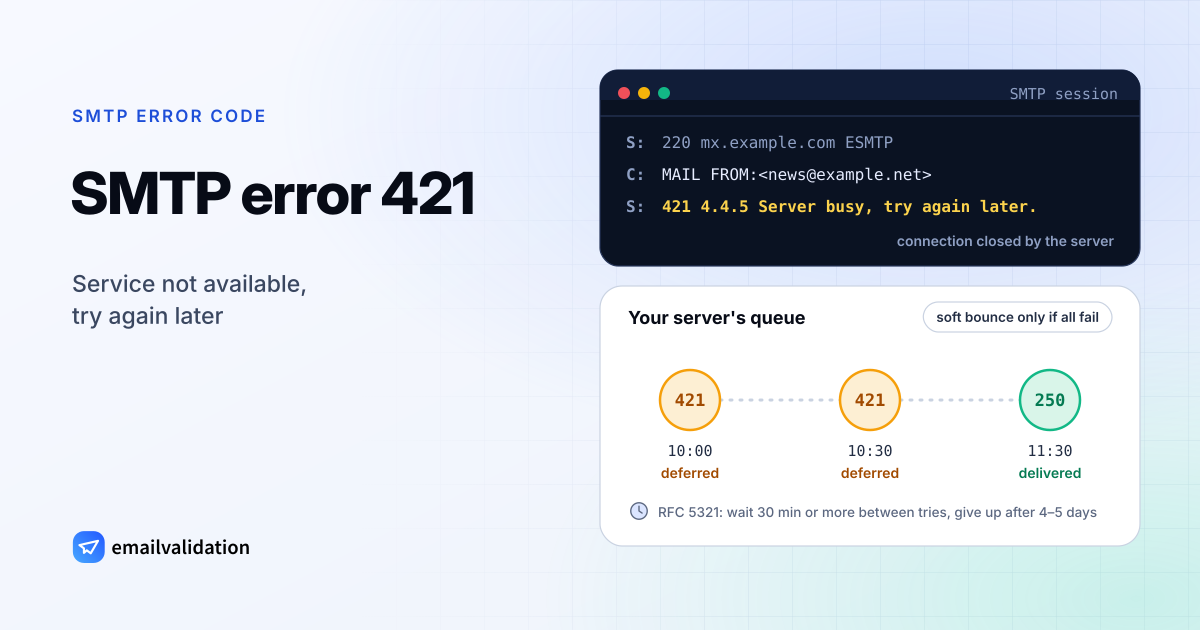
What SMTP error 421 means
RFC 5321 defines SMTP error 421 as “<domain> Service not available, closing transmission channel”, and adds: “This may be a reply to any command if the service knows it must shut down.” Two things set it apart from other temporary errors. It can come as the answer to any command, not just to a particular recipient or message. And the receiving server hangs up after sending it.
Your mail server treats a 421 as a deferral. It keeps the message in its queue and tries again; RFC 5321 (section 4.5.4.1) says “the retry interval SHOULD be at least 30 minutes” and that “the give-up time generally needs to be at least 4-5 days.” Only if every attempt fails until then do you get a bounce. The guide to hard vs. soft bounces explains how email services count that.
421 error messages by provider
Large providers put the actual reason after the code. Gmail uses 421 a lot; these are excerpts from Google’s SMTP error list:
| Gmail reply | Reason |
|---|---|
421 4 | A problem on Google’s side |
421 4 | Load on Google’s side |
421 4 | The recipient’s domain requires an encrypted connection |
421 4 | Reverse DNS for your IP is missing or doesn’t match |
421 4 | Reputation (other texts name the domain, or the content and links) |
421 4 | Neither SPF nor DKIM passed |
421 4.7.27, 4.7.30, 4.7.40 | Rate limited because SPF failed, DKIM failed, or the domain has no DMARC record |
421 4 | Too much mail, or too much unwanted mail, from your IP or domain |
421 4 | No TLS |
Yahoo’s sender help treats 421 and 451 together as “a temporary problem blocking the delivery of your message”. Its list of causes: unusual traffic from your IP, content that looks like spam, complaints from Yahoo users, busy servers, a name server that can’t be reached, or a failed authentication lookup.
What causes a 421 error
- The receiver is busy or under maintenance. Nothing to do; the next attempt usually works.
- You are sending too fast. Providers throttle new or suddenly busier senders, and senders with complaints.
- Authentication is missing. Gmail’s 4.7.26 to 4.7.40 replies are temporary versions of blocks it applies with 5.7.x codes. Treat them as a warning.
- Your server setup. No PTR record, a PTR record that doesn’t match the server’s name, or no TLS.
- Greylisting. Some servers refuse the first attempt from an unknown sender on purpose and accept the retry. RFC 6647 names 421 (with the connection closed) as one of the two reasonable replies for that.
How to fix SMTP error 421 as the sender
- Let the retries run. Don’t resend by hand: when the original goes through later, the recipient gets it twice.
- If it lasts more than a few hours, read the enhanced code.
4.3.xand4.4.xare about the receiver.4.7.xis about you. - Set up reverse DNS. Ask whoever runs your server’s IP address to set a PTR record that matches the server’s host name.
- Turn on TLS for outgoing connections on your mail server.
- Fix authentication. Publish SPF with the SPF record generator, turn on DKIM signing with your own domain, and add a record with the DMARC generator.
- Slow down and clean up. Spread large campaigns over time, warm up new IP addresses gradually, and stop mailing people who never engage. The email deliverability guide covers the long-term work.
If you send through an email service, it handles retries. Its logs show the deferrals; act when one domain keeps deferring you for days.
If you run the receiving server
A 421 from your own server is fine during maintenance or overload. If legitimate senders report long delays, check your rate limits and greylisting setup: an allowlist for known partners avoids delaying their mail. Remember that RFC 6647 notes some clients never retry, so their mail is lost on the first temporary refusal.
Would email verification have prevented it?
No. A 421 says nothing about whether the mailbox exists, and the same address can be deferred today and accept mail tomorrow. Verification helps with one cause behind rate limits, though: sending to many dead addresses. Yahoo lists “excessive unknown recipients” as one of its error categories. Checking a list with the bulk email verifier before a campaign keeps that number low.