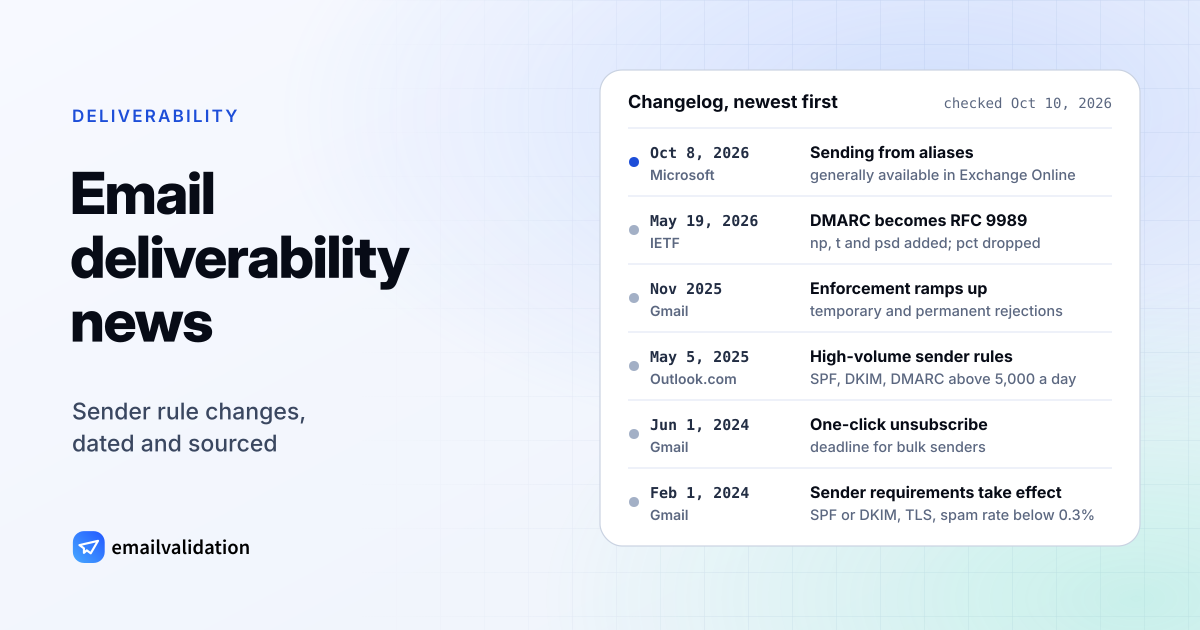
This page collects email deliverability news from the source: each item is a change that Gmail, Yahoo, Microsoft or Apple announced on its own pages, or a document the IETF published, with its date and a link. Newest first. It doesn’t repeat third-party reports, and where a provider gives only a month, so does this page. For the full requirements behind each change, read the Gmail, Yahoo and Outlook sender requirements.
Last checked: October 10, 2026.
This month: October 2026
No new provider rule changes so far in October 2026 (checked October 10, 2026): Gmail, Yahoo, Microsoft and Apple announced no new requirement for senders. One Microsoft feature change touches sending:
- October 7, 2026 – Exchange Online: sending from aliases is generally available. Exchange Online users can now send from any alias (proxy address) on their mailbox, not just the primary SMTP address. Admins turn it on with
Set-OrganizationConfig -SendFromAliasEnabled $Trueor under Settings → Mail flow in the Exchange admin center. Microsoft’s announcement lists known issues that remain, so review them before you turn the feature on for everyone (Microsoft Exchange Team Blog; Office 365 for IT Pros). Our note: if an alias sits on a different domain, that domain needs its own SPF, DKIM and DMARC, because receivers check the domain in the From line.
Checked on October 10 and unchanged:
- Gmail: the sender guidelines FAQ still names November 2025 as the latest enforcement step.
- Google Postmaster Tools: the old (v1) interface is still due to be retired, but Google has postponed the date: “Stay tuned for more information on timing.” The Domain and IP reputation dashboards are retired and are not part of the new version (Google).
- Yahoo: the Sender Hub requirements are unchanged since enforcement began in February 2024.
- Outlook.com: the postmaster policies still list the high-volume sender rules in force since May 5, 2025.
Email deliverability news archive by month
September 2026
- September 8, 2026 – IETF: Aggregate Performance Reporting, revision 01. An Internet-Draft with authors from Comcast, Iterable and Google proposes a standard format for aggregate reports on email performance, a DNS record that says where to send them, and a way to deliver them. It is a draft, not a standard (IETF Datatracker).
- September 2, 2026 – Exchange Online throttles and blocks outdated Exchange servers. From the second week of September 2026, Exchange 2016 and 2019 servers that send to Exchange Online through an inbound connector of type
OnPremisesneed at least the October 2025 public update, or their mail is throttled and then blocked. Microsoft expects to raise the minimum again in several months, after which only servers in the Extended Security Update program or on Exchange SE will avoid it (Microsoft Exchange Team Blog).
May 2026
- May 19, 2026 – DMARC becomes RFC 9989. RFC 9989 obsoletes RFC 7489 and RFC 9091. Aggregate reports moved to RFC 9990 and failure reports to RFC 9991. New tags:
np(policy for subdomains that don’t exist),t(testing mode, one policy level lower) andpsd(for public suffix operators). Thepcttag is gone;t=yreplaces it for testing. Existing records keep working. Tag by tag: what is a DMARC record. - May 1, 2026 – BIMI Internet-Draft, revision 14. The BIMI specification is still an individual Internet-Draft with no formal IETF standing; revision 14 describes the record format
v=BIMI1; l=…; a=…atdefault._bimi(IETF Datatracker). How the records work: BIMI and MTA-STS explained.
April 2026
- April 23, 2026 – Microsoft 365 previews a Promotions folder. With the anti-spam setting “Bulk Moves Enabled”, Outlook routes non-spam bulk mail below the organization’s Bulk Complaint Level threshold to a new Promotions folder instead of the inbox; spam still goes to Junk. Moving a message back to the inbox stops future routing for that sender. The feature is in public preview; Microsoft says the Promotions tag will be on by default once it is generally available. It concerns mail to organizations on Microsoft 365 whose admins turn it on; the post doesn’t cover Outlook.com (Microsoft Defender for Office 365 blog).
January 2026
- January 2026 – Exchange Online cancels the Mailbox External Recipient Rate Limit. The per-mailbox limit on external recipients that Microsoft had announced for Exchange Online won’t be introduced (Microsoft Exchange Team Blog). The general recipient rate limit of 10,000 recipients per mailbox a day still applies (Exchange Online limits).
November 2025
- November 2025 – Gmail ramps up enforcement. Google: “Starting November 2025, Gmail is ramping up its enforcement on non-compliant traffic.” Messages that don’t meet the sender requirements “will experience disruptions”, including temporary and permanent rejections. The requirements themselves didn’t change (Google sender guidelines FAQ). Gmail’s authentication rejections are explained in 550 5.7.26.
July 2025
- July 8, 2025 – Gmail adds Manage subscriptions. A view that lists subscription senders by how often they send, with a one-click unsubscribe; “Gmail will send an unsubscribe request to the sender on your behalf.” Rolling out on web, Android and iOS in select countries (Google).
May 2025
- May 5, 2025 – Outlook.com requirements for high-volume senders take effect. Domains that send more than 5,000 emails a day to Outlook.com need passing SPF and DKIM and a DMARC record of at least
p=none, aligned with SPF or DKIM. The postmaster policies say non-compliant mail goes to the junk folder and, if problems remain, may be rejected with550; 5.7.515 Access denied, sending domain [SendingDomain] does not meet the required authentication level.(Outlook.com postmaster policies).
April 2025
- April 2025 – Microsoft announces the Outlook.com rules. Microsoft announced the high-volume sender requirements for Outlook.com on its Tech Community blog, with an “April 29th Update” that changed the action taken on messages that don’t meet them (Microsoft Tech Community). The rule that applies today is the one on the postmaster policies page, checked October 10, 2026: junk folder first, then possible rejection with
550; 5.7.515.
February 2025
- February 25, 2025 – Apple’s iCloud Mail postmaster page lists bulk sender rules. In the version published that day, Apple says “all requirements must be met in order to send a bulk email” to iCloud Mail, otherwise the mail is rejected. The list: recipients who opted in (no purchased or appended lists), an unsubscribe link, SPF and DKIM, a DMARC policy, reverse DNS, mail that complies with RFC 5321 and RFC 5322, ARC headers on forwarded mail, consistent sending IPs and From addresses, and handling of bounces and inactive subscribers. iCloud Mail has no allowlist and no feedback loop for bulk senders (Apple).
October 2024
- October 16, 2024 – Apple announces Branded Mail. Businesses verified in Apple Business Connect can show their name and logo in the Mail app (Apple Newsroom). To register a domain, its DMARC record needs
p=quarantineorp=rejectandpct=100(Apple Business User Guide).
September 2024
- September 24, 2024 – Gmail accepts Common Mark Certificates for BIMI. Senders without a registered trademark can show their logo with a CMC; senders with a Verified Mark Certificate (VMC) also get the verified checkmark, which now appears in the Gmail apps for Android and iOS too (Google Workspace Updates).
June 2024
- June 1, 2024 – Gmail deadline for one-click unsubscribe. Senders that already had an unsubscribe link had until this date to add one-click unsubscribe to all commercial and promotional messages (Google sender guidelines FAQ). One-click means the two headers from RFC 8058, both covered by a valid DKIM signature, with an HTTPS address in
List-Unsubscribe:
List-Unsubscribe: <https://example.com/unsubscribe/opaque-token>
List-Unsubscribe-Post: List-Unsubscribe=One-Click
- June 2024 – Gmail stops mitigation above a 0.3% spam rate. “Beginning June 2024, bulk senders with a user-reported spam rate greater than 0.3% will be ineligible for” mitigation (Google).
February 2024
- February 1, 2024 – Gmail sender requirements take effect. All senders need SPF or DKIM, valid forward and reverse DNS, TLS (added to the list in December 2023), messages formatted per RFC 5322, and a spam rate below 0.3% in Postmaster Tools. Senders of more than 5,000 messages a day also need SPF, DKIM and DMARC with an aligned From domain, plus one-click unsubscribe. Since February 2024, Google provides no delivery mitigation to senders that don’t meet the guidelines (email sender guidelines, FAQ).
- February 2024 – Yahoo starts enforcing its sender requirements. Nearly the same list as Gmail’s, rolled out gradually while Yahoo monitored compliance through the first half of 2024 (Yahoo Sender Hub).
Rule tracker: Gmail, Yahoo, Microsoft, Apple
The rules each provider documents today, checked October 10, 2026. “Since” is the date the rule took effect; where a provider gives no date, the column says so.
| Provider | Requirement | Applies to | Since | Source |
|---|---|---|---|---|
| Gmail | SPF or DKIM; valid forward and reverse DNS; TLS; RFC 5322 format; spam rate below 0.3% (Google’s target: below 0.1%) | All senders to personal Gmail accounts | Feb 1, 2024 (TLS: Dec 2023) | |
| Gmail | SPF and DKIM and DMARC (p=none is enough); From domain aligned with SPF or DKIM | Bulk senders: close to 5,000 messages a day or more; once reached, permanently | Feb 1, 2024 | |
| Gmail | One-click unsubscribe (RFC 8058) and a visible unsubscribe link in marketing and subscribed messages; Google recommends handling requests within 48 hours | Bulk senders | June 1, 2024 | |
| Gmail | BIMI logo: DMARC p=quarantine or p=reject, SVG Tiny PS logo, VMC or CMC | Optional | CMC accepted since Sep 24, 2024 | |
| Yahoo | SPF or DKIM; spam rate below 0.3%; valid forward and reverse DNS; RFC 5321 and 5322 | All senders | Feb 2024 | Yahoo |
| Yahoo | SPF and DKIM; DMARC of at least p=none that passes, aligned; one-click List-Unsubscribe (RFC 8058 POST “highly recommended”, mailto: accepted) and a visible link; honor unsubscribes within 2 days | Bulk senders (no number published) | Feb 2024 | Yahoo |
| Yahoo | BIMI logo: DMARC p=quarantine or p=reject, SVG logo, no VMC required, sufficient reputation; bulk mail only | Optional | Not dated | Yahoo |
| Microsoft | SPF and DKIM pass; DMARC at least p=none (p=reject recommended), aligned with SPF or DKIM | More than 5,000 emails a day to Outlook.com | May 5, 2025 | Microsoft |
| Microsoft | An unsubscribe mechanism that is “clearly documented and easy for recipients to find and use” | All senders to Outlook.com | Not dated | Microsoft |
| Apple | Opt-in recipients, unsubscribe link, SPF and DKIM, a DMARC policy, reverse DNS, RFC 5321 and 5322, ARC on forwarded mail; otherwise rejected | Bulk senders to iCloud Mail (no number published) | Not dated; page version of Feb 25, 2025 | Apple |
| Apple | BIMI logos in Mail: DMARC and a VMC or other BIMI evidence document | iOS 16, iPadOS 16, macOS Ventura 13 or later, iCloud.com | Not dated | Apple |
| Apple | Branded Mail (Apple Business Connect): DMARC p=quarantine or p=reject with pct=100 | Optional, verified businesses | Oct 2024 | Apple |
To see where your own domain stands, send a test message to the email spam checker: it reports SPF, DKIM, DMARC, reverse DNS and List-Unsubscribe in one go. If the DMARC record is missing, the DMARC generator writes one. Authentication gets mail accepted, while reputation and list quality decide the folder: the email deliverability guide covers those, and bounces from old addresses are a reason to reduce your email bounce rate before the next send.
Sources
All opened and checked October 10, 2026:
- Google: Email sender guidelines, Email sender guidelines FAQ, Postmaster Tools v1 deprecation, Set up BIMI, Gmail: additional BIMI protections, Manage subscriptions
- Yahoo: Sender Hub best practices, BIMI
- Microsoft: Outlook.com postmaster policies, High-volume sender announcement, Exchange Online limits, Exchange Team Blog posts on sending from aliases, outdated Exchange servers and the canceled external recipient rate limit, Defender blog on the Promotions folder
- Apple: Postmaster information for iCloud Mail, About BIMI support in Apple Mail, Branded Mail DMARC requirements, Newsroom, October 16, 2024
- IETF: RFC 9989, RFC 9990, RFC 9991, RFC 8058, BIMI draft, Aggregate Performance Reporting draft